

Socialising and keeping your brain active: Professor Ngaire Kerse
We’re putting different aspects of brain health in the spotlight for Brain Awareness Month this March. Joyce Cook Chair in Ageing Well at the University of Auckland Professor Ngaire Kerse explores socialising and keeping your brain active
Q. How does socialising keep your brain healthy?
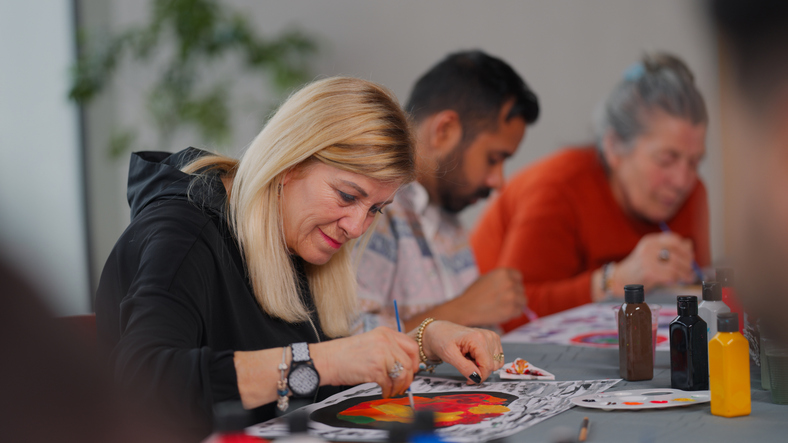
A. I don’t know if you’ve noticed, but whenever you socialise, you’re actually talking to somebody, usually listening to that person and hopefully contributing something. So, I think here we’re talking about social engagement, social contact… not just going to a movie
or going to watch something. So, socialising – that contact with other people – it uses many, many areas of your brain. You often have to listen, process language, and use language, in different kinds of ways. The emotional engagement is also very good for cognition and keeping your brain well, particularly if that social contact is of a positive nature and you end up in a good mood, if you know what I mean.
Q. How does doing activities you enjoy keep your brain healthy?
A. Similar to general socialization, if you’re doing something that you enjoy, that sense of good mood, that sense of wellbeing that comes after doing something or during something that you enjoy, tends to maintain that sense of wellbeing for longer. It’s good for your brain to be in a good mood. Doing things that you enjoy are often very reinforcing because you’ve done them before, you enjoy them, and you know how to do them. You build confidence from doing things that you enjoy and that helps you to do potentially things that might be more challenging for you. And so, it’s a combination of brain activity, engaged in whatever it is that you like, the confidence that comes from doing what you like, what you enjoy doing and also the good sense of wellbeing or the mood enhancement that comes with doing things that you enjoy. All of those things keep your brain active and healthy.
Q. Why are these important for reducing your risk of dementia?
A. Well, there’s been a lot of literature. So, people who do more physical activity are less likely to get dementia. People who have complicated jobs where they have to use their cognition a lot are less likely to get dementia. People who are bilingual, have many languages, tend to be less likely to get dementia. When you take into account all of those things, also keeping well, of course, not having strokes, not having significant heart disease. But if you take all those other things into account, there was still an independent association between people who are socially active and a lower risk of dementia subsequently. And that social activity, when you look at what it is, it is more protective if that social activity is regular, involves several different things, and if it involves physical activity. For instance, going to museums with somebody is protective of dementia. And we think that is because when you go to museums, you’re looking, you’re reminiscing about something that you’re looking at, you’re recognising something. There’s a whole lot of things, you’re making connections. So there’s something about making connections that is quite protective. And the other thing that I like to talk about a lot is ballroom dancing. It doesn’t have to be ballroom dancing, but any complicated physical and social thing where you’re engaging with someone else and having music involved is quite protective of dementia later.
Q. What are some examples of social connection and activities as we age
A. Okay, so it’s really good to team the social contact or social activity with other lifestyle things that are useful. So, for instance, when older people, as people age, they eat less and they eat less range of food. So actually eating together is a fantastic social activity. So have a group lunch, have a community gathering involving food. And the reason I say that’s good is because older people eat 20 percent more if they’re eating with someone else and they tend to eat a greater variety of food. So, eating together is a great social activity and it doesn’t have to be expensive. So going out, or going out of the house to have social activity, is also important because that’s teamed with actually getting out of the house and all of the cognitive challenges that come with it – from driving your car, from navigating the footpath, getting on the bus, etc. So social contact that is involving reminiscence is good. This could have any form – whether it’s speaking with an older relative about the family tree, whether it is going to a museum with someone and seeing the old toaster or the old jug. That kind of aspect of things from the past that you’re connected to helps to reactivate that area of your brain, which has ongoing activation or sequential stuff that happens in the brain. And then there’s the social activities that actually involve cognition. So I think I’m going to learn to play bridge because going along, learning a new skill, which would be bridge, I used to play cards when I was a child, and then the interactions around the table at a bridge table.
But in late life, you need to actively continue to socialize. And I mean, it’s silly, isn’t it, to put it in your diary, I’m going to socialize. Make it something that you enjoy and make sure that it happens regularly. If it can involve physical activity as well, I think that’s very good. And the physical activity should be as cognitively challenging as it can be. And that’s why dancing is good, because it’s social, it involves music, which does lots of things with your brain and it’s exercise. as well as the social contact. I think anything we can do to actually engage the whole population in talking about brain health is good. And brain health has to be through the life course. So brain health for children is reading books, doing new things, playing on the gym and falling off on the monkey bars. Brain health for midlife people is making sure you don’t get too stressed out at work, maintaining physical and social activity, doing things that you enjoy. Brain health for older age in the social activities is really important.
More on brain health